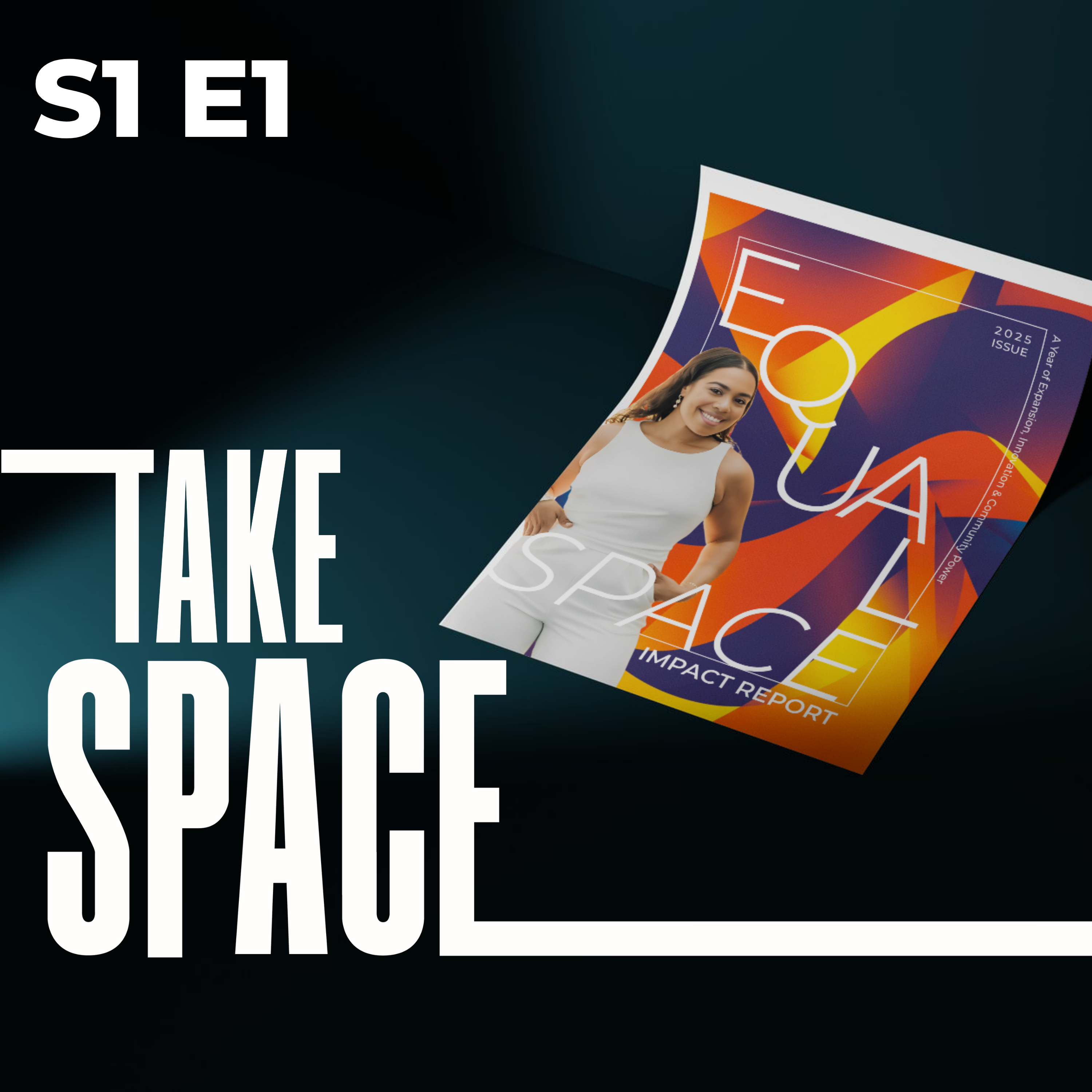
Episode Transcript
[00:00:02] Speaker A: Hey, everyone. I would like to welcome you to a very special podcast.
You see, it's that time of year, that magical end of the year, and we at Ecospace have been obsessed with thinking about our impact.
And as many organizations do, we try to really bring together all of the cumulative impact we've made in our city of Newark and now in our state. But that's just the numbers. I think what's really about it is the stories that go beyond the Those numerics. Right. Who are we really impacting? Who are our people? And so this podcast is really that through line, it's telling the stories of why we do what we do and bringing it to life for you. So I can't tell you how excited I am, because we're going to be bringing the team together, we're going to be bringing our amazing spacers together to really tell you who is equal Space, why do we do this work and what happened in 2025.
And so our first guest is no other than Janie Pilgrim, who is the founder of the Deal Career Solutions. It's an organization dedicated to bringing individuals with learning differences, including autistic and neurodiverse job seekers.
They gain meaningful employment through the journey that Janie and her team provides. And I have to tell you, she started in one of our small suites. But the dream and impact has been big.
And so what does that mean?
Year by year, Janie and her team have grown, and now they're in one of our largest and have added another suite just recently to make more impact. And clients continue to grow in their needs. Her journey is exactly why equalspace exists. And I can't tell you how excited I am to have you learn more about Janie.
[00:01:51] Speaker B: Tina, that was amazing. I was like, I want to meet this Janie.
[00:01:54] Speaker A: Listen. And I get to see you. So, like, people need to know the gift. The gift of getting to, like, talk with you and understand you, but also on the days that are hard, seeing your work and their team's dedication to your work fill my tank up. And I don't know if I've ever been able to tell you that. And, like, it's weird to do it on a podcast and be like, you really do fill my cup. But we all have rough days, and I think the purpose keeps us in it. But for people who might not even know which y' all should be in the know.
Can you talk to us a little bit about what is the deal and who do you serve?
[00:02:29] Speaker B: Sure.
We started. I started the deal in 2012, but I really didn't start to grow the business until the pandemic happened. So a lot of people was an awful time for many people. But for us, it was an opportunity to fill a need.
Since then, we started out with supported employment. What supported employment is finding people with disabilities employment.
Then we expanded to focusing on individuals with autism and down syndrome and Asperger's and intellectual disabilities. And we find them housing. We provide cooking classes, we provide a social environment. Because so many times after they leave high school, they lose that social network. They have their families, but they lose contact with their friends.
So if any service that would provide for anyone with a disability, our service meets that need.
[00:03:35] Speaker A: And we're talking about needs. And I would love to elaborate about helping people with learning differences.
How do you help them to build the skills and the confidence and also the workplace success?
Like, what does that look like? But also what motivates you in this work?
[00:03:54] Speaker B: So let me start with what motivates me, right?
[00:03:57] Speaker A: I love. I love a flip.
[00:03:58] Speaker B: Yeah, let's start with what motivates me. So as I think about what motivates, motivates me day to day. And it's the families we serve, honestly. And we see our young people, we actually call them children, our children, but they're young adults because they feel like they're part of our family. We see them grow and being in equal space and allowing them to kind of like blossom. And this space has been kind of a nurturing ground. We've been able to doing the cooking and then we have the art classes and we have access to the three floors. So it doesn't. Although we have an office, it feels like we have a complex that we can go to to be able to provide different services. And some individuals who may have been shy when they first show up, we see them blossom just through the relationships and learning.
And so how do they.
Success is different for everyone.
So one way we measure success is if we can find someone employment and have them sustain the employment. So that's success. That's one level of success. But then when they get employment and they sustain employment and we can find them an apartment, that's even greater success. And what I really think is success when families call me and they want our help in ways that feels like a family, that makes me feel like we're doing something right.
[00:05:21] Speaker A: And that's. That's beautiful to just talk about is like, the work you're doing directly impacts family, directly impacts the individual who then goes out into the world and makes the world a better place. It's such a like ecosystem of a ripple effect of what you do.
How has the journey for the clients, how has it been for them? You talked about them blossoming in the space.
What spaces for them have been like their favorite spaces. I'm always curious.
[00:05:50] Speaker B: Actually it's funny because what, everyone loves the event space, right? Like, I love the event space and we use that for special events. But for the day to day blossoming, the area we're on the fourth floor, that kitchen area. I think, you know, even in your own home, the kids, the kitchen is a central place being in that kitchen because we, you know, make sure that they have breakfast and have lunch.
So it feels like a family environment. So I think that whole area with the kitchen and we all intermingle and play Uno. Uno is a big game for us and we play Monopoly so we could teach them how to manage money.
So I think that kitchen area is one of the best places I know.
[00:06:27] Speaker A: It'S one of my best places to walk through. Because your team, your team makes some great meals in that space. I'm always like, wow. I was like, I gotta get my cooking game up. I thought I was doing it, but I'm not.
We're, we're, we're at the end of the year and, and I feel like every year I think I'm prepared for it and then it comes in, it like smacks me in the face. I'm like, oh my God, we have a couple weeks left, right? As we're looking forward to 2026, like, what are you excited to build next?
[00:06:54] Speaker B: That's a good question. It's interesting question because speaking of AI, as you know, we all evolve. I was asking chat gdp, I was like, hey, like, because it knows a lot about me because I use a lot of it. So I was asking it about like next steps for the company and for me. And one of the things, in terms of me personally, it was saying things to do so the executive director doesn't have burnout.
And it's funny because I was like, I don't feel burnt out. But I guess you know just how much it sees that I want to do and it. And one of the, one of the things that said is continue to do what's working for you and start eliminating those things that are not working and don't expand yet for 2026. First quarter, continue to do it's working.
Second quarter, make sure you flush it out. Third quarter, then start to expand in other ways. But there are areas in 2026 we want to Expand the support and employment. But in schools, like right now, we do it kind of like one on one, but to do it in school. So that's probably going to be later on within 2026.
And one way we could, it doesn't take a whole lot of effort is to obtain more clients.
Right. And just provide the services that we have because they're great services and have them enjoy the space like we do.
[00:08:17] Speaker A: Oh, I think that's such a beautiful takeaway though is like we think about planning for 2026 to be additions. What a wonderful thing to offer is it could be deletions, it could be subtraction so that you're more honed and lighter even to carry on the good work. I think that's such beautiful place to be. Be there. And so if people wanted to find you and, and the deal, where could they find you?
[00:08:44] Speaker B: Right, that's easy. I'm going to give out my personal number because it goes through a system and we can vet it and someone will answer you. Is 732-723-7307. That's 732-723-7308. Or they could check out the website, which is the dealcareers.org the deal careers work.
[00:09:08] Speaker A: I can't thank you a for being a part of our community because you're the reason we exist. You're literally our mission. And more importantly, I can't wait to see how things unfold in 2026. I thank you for sharing time in a busy season with us and I'm so happy that people are going to get to know your story even further. So thank you, Janie.
[00:09:28] Speaker B: I'm excited and I just want to say I didn't get a chance to say thank you to Equal Space when I sat down, but you saw our vision and you've seen us grow and this space has been a great ecosystem in order to bring our clients in and for us to grow and for it to feel like home. So thank you for that.
[00:09:49] Speaker A: Low key me being emotional. Blame it on December, y'.
[00:09:51] Speaker C: All.
[00:09:52] Speaker A: Blame it on December. It's true. It's true. So again, Janie, founder of the Deal, and again, tap on her social and the number she provided to learn more and support this amazing organization.
[00:10:04] Speaker B: Thank you so much.
[00:10:11] Speaker A: So again, everybody, you're hearing about 2025 and you're gonna hear it through different lenses and I don't think there's a better person on the team to talk about who we've been and what we've been up to from the side of, like, our people than Angie. Angie is our culture engagement coordinator, Literally the person who creates the feeling, the warmth, the welcome that defines Equal Space. She's the first person you see in so many instances and definitely is the person who checks up on you when you don't think you need checking up on. And so I'm so excited to bring Angie and have this one on one conversation about 20, 25.
[00:10:59] Speaker D: Hi.
[00:11:00] Speaker C: Hey. I haven't done this in so long.
[00:11:03] Speaker A: I know, but it's. It's the best time to come back. You want to know why? Because we're not pretend and we're not trying. We're literally going to chop it up and tell people things that they don't see about us. Because we publish this really polished impact report and I don't think they understand, like, the journey we go through through the year.
[00:11:19] Speaker C: I agree.
[00:11:20] Speaker A: Where you go? Damn, we did all that. I looked at some of the beginning stuff in that impact report and I was like, wow, that was. It felt like forever ago. And so when we're talking about our people.
[00:11:30] Speaker D: Right.
[00:11:31] Speaker A: What do people usually feel or say when they walk into our campuses for the first time? Because I don't want to say. I get numb to it. Sometimes I walk into our space and I'm like, home. But like, what do people when they're coming in? Because you're their first person.
[00:11:45] Speaker C: Yeah.
I love doing the tours and meeting people when they come to this space. And I always get like two different reactions. One is for the people that come here for the first time that are probably not from Newark. And it's a mix of like, shocked, but like a pleasant shock because they're like overwhelmed by everything that we have to offer here at Equal Space. And it's always funny to like, get their reaction because they're just like, every time you're giving them a tour, you show them once, but they're like, wow. And wow, you guys have all this to offer.
So it really is a true testament to like, how much of a one stop shop Equal Space is for a lot of our members and community members. And then you have people that are community members and they know about us and they come and they're just like, they don't want to leave because they're like, it's so much fun here. It does not, you know, we are a co working space, but it does not feel like one. So, like, you can find your little area to work in and it feels so comfortable. So a lot of people just like, we. I'm coming back Like, I. Now I. Now that I know where it's at, now that I've seen it, I'm coming back. So it's like. It's two different type of reactions, but they're both really great ones.
[00:12:58] Speaker A: I don't get tired of it, too. I love. I love when the red elevator door opens and they first walk out and they're in the living room and they're like.
And I love that so much. But you lead something that most people can't define, right? You're the culture of the space. In many instances, you're the heart and the feeling of the space, which I'm always so grateful to you for, because it takes a lot of energy and intention to consistently give that. But I don't think I've ever heard you share. And I want people to find out, what does community mean to you here at Equal Space? What does. What does that bring up for you?
[00:13:35] Speaker C: Wow. Well, community here means everything. I feel like the minute you walk into our space, it does not feel like a workplace. It feels like community to be able to come into a place where you know you're supported.
If you need help by. With something, you know that you can go to somebody. If it's not a staff or a team member, even just like a. A, A fellow friend. Like, you know, it's so big here, and I think we thrive on community here.
A lot of our members, they come here looking forward to seeing us or seeing the other members. They really work together.
When there's events, we always try to make sure everyone feels supported.
We promote events. So it's really a big thing. And it's really the biggest reason why Equal Space is so great and successful is because we're so big on community and we allow people to show up as themselves and not feel afraid. Like, sometimes you walk into a place and you're like, I don't know if I want to ask for help. But here you don't feel like that. Like, you feel like, I can ask someone for help because you know, they can help you.
[00:14:42] Speaker A: And do they ask you for help?
[00:14:44] Speaker C: Yes, they do.
[00:14:45] Speaker A: Yes. You get your steps in, girl. The steps happen in this. I have seen you go up and down the stairs, and I love that our members are not shy to be like, I don't know about this. I need this. For anyone who doesn't know, we call Angie the Great Plug. Cause Angie knows everyone, not just in the space. Cause we think of community in space. But like, you refer and say, oh.
[00:15:07] Speaker C: Yeah, no, it's one of My favorite things to do here is saying, oh, I know somebody that can help you with this, or I know this or I can do that. Like, it's one of my favorite things here.
[00:15:16] Speaker A: It's like I know someone who knows someone and it works. And these and our members are grateful for it. And that network you foster through your own journey. And it's beautiful that you keep the book open because that doesn't happen a lot. And so I know what you empower. But I would love to hear your feelings. When members like Janie, who we just talked with, when they grow, what does that show you about the environment that you're supporting? Like, when you see Janie's now got.
[00:15:45] Speaker C: Another shape, I feel so proud. I remember when Janie started here, I think she had like a team of like two people and maybe like six students at most. And just to see her where she's at now with a team of like over 10 people and over 20 students. And I see them in the space all the time and even just to see the difference in the students too. Like, some of them were very quiet and timid when they first started coming here and now they're just like, they run and give me hugs. They be telling me about their weekends.
So overall, the growth in her company and her students has been so amazing to see and I'm super proud of her because she's. She not only grew within equal space, but like I can see her company growing as well. Like now she has three spaces with us instead of two.
So I'm excited.
It really makes my job satisfying just to see that we're able to help and support them in any way. But no, it's amazing and I hope that we have 100 more Janies in the future.
[00:16:50] Speaker A: I agree. I agree. Here's to 100 more Janies. Okay, it's the last question, which is so wild, but it's 2025 crazy. What are you most proud of from this year?
[00:17:03] Speaker C: Oh man.
Like I said in the beginning, it's just so much we've done this year. But honestly, I would say I'm most proud of cultivating like the events that we do every year. I say this is the best, this is the best. North Tech Week, this is the best. But then we have them and they over exceed the year before.
So I'm really proud of the hard work we put in to make events better each year and just the growth in our in an equal space period. Like this year we started with both our spaces weren't full with members and now we're ending the year with both our spaces almost completely full with members. So I'm really proud of that, and I'm really proud to see our community build. I'm proud to see our growth, and I'm also proud of my personal growth in the company as well.
[00:17:49] Speaker A: Listen, even our market space that we just had was, like, overwhelming success. Oh, my gosh. Our stage productions have gone.
[00:17:56] Speaker C: Yep. Market space, North Tech Week, Small Business Week. Everything has been so much better this year, and I'm super excited about the stuff we got working for next year.
[00:18:06] Speaker A: And as part of our end of year report, even doing this podcast is a stretch for the whole team that I think we're, like, rising to and shout out to Kelly, the great organizer of this impact report.
Right. And Mark putting up the visuals. But it also has given me, like, a rare moment because I actually get to express, like, to your face, gratitude because this year has also been a year where we have fought not only to be like, we're not only just the city of Newark anchor, we're also now anchoring in the state level.
And that's a testimony to how dope our team is. And it still feels like us. And that's due to your weaving. You make sure, but you make sure our stuff feels like us, that we don't get lost in the sauce or lost in the scale. And I have to thank you. I'm so grateful to you for that.
[00:18:52] Speaker C: Yeah, of course. I will always keep us grounded, Angie.
[00:18:56] Speaker A: Keeps it real. And so I have to thank you for. For contributing to this end of year podcast and 2026. We're gonna do bigger and better things. Yes.
[00:19:06] Speaker C: I'm excited for it.
[00:19:08] Speaker B: Yeah.
[00:19:12] Speaker A: So 2025 had us experiencing a whole other moment of seasoning.
We were running two campuses, and ecospace has done that in its past, but this was on an entirely different scale.
It led to a lot of questions throughout the years. How do we keep our operations clean and how are we financially making sure that we're not only keeping it sustainable, but also growing the impact? And that takes financial resources.
Those aspects of the business are completely helmed by Jonathan Collins, our chief operating officer. And when I tell you running multiple campuses is a daunting task, I would be making an underwater understatement. So I'm so excited for you to actually hear from Jonathan, who tends to like to be behind the scenes, what it's been like for us to be in our second year of operating two very large campuses.
[00:20:12] Speaker D: How's it going?
[00:20:13] Speaker A: You know, it's Going well. It's going well. I think year two together in this multi campus model has seen us spend a lot of time together.
[00:20:25] Speaker D: Yep.
[00:20:26] Speaker A: Late nights, a lot of late nights. A lot of hard questions about operating a business, but more importantly, doing what we do in downtown Newark. Right.
And you are a downtown Newark resident and you can attest to how fast the city is scaling, right?
[00:20:44] Speaker D: Oh yeah.
[00:20:45] Speaker A: And so our, our role, our mission, our side of the, of the coin is that we're helping our members equitably build wealth. And so we have to be stewards ourselves of how we're running our model in order to coach and you coach our ambassadors. So they're looking to us to lead the way. And so what does it actually take to run a multi campus environment like equalspace from your vantage point Scol?
[00:21:11] Speaker D: A lot of it's communication, Kansei, talking to the team about what the next projects are, what the day to day looks like over communicating, just making sure that nothing gets missed.
And also going through your favorite phrase, inspect what you expect.
[00:21:27] Speaker A: Inspecting what you expect. I don't think the end of year report could capture that. It's not just in the data, right? It's not just that. The outcomes, the journey of inspecting what you expect, what are the vehicles that you've been using with our team to do that?
[00:21:45] Speaker D: I mean the big one we always use is slack to communicate constantly. And then having consistent team meetings, whether that be the day to day stuff, whether that be the meetings about the specific topics or the reporting at the end of the day, making sure that we're all following up with what our tasks were completed, what has been left the following day so that our teammates that come in the next day aren't left wondering what to do.
[00:22:13] Speaker A: It's the wondering part like we have to completely keep connecting it.
This year 2025 has seen us go from supporting the individual dreamer, individual founder, to teams that have grown over 30 to teams that have graduated and like are taking and commanding larger spaces of their own.
How do you think this year has positioned us in the expansion of ES550 into an innovation campus?
[00:22:45] Speaker D: There's been a lot of movements and a lot of growth within the city itself besides just us.
But because of all that outside growth, we've had to kind of level ourselves up.
Whether it be taking better accountability for our own finances and tracking that, better creating new systems for ourselves, creating new checkups and follow ups with each other.
And then it is doing a new wave of marketing, changing how we engage people, changing the messaging that we have when they do get in the room and why it's important that, that we continue to do the work we do and why and who it's impacting.
[00:23:27] Speaker A: It's the whole the who really is our why.
[00:23:30] Speaker D: Right.
[00:23:30] Speaker A: And, and I couldn't think better of our city. You had just mentioned, like, how Newark has, has expanded. Right. Why is Newark the perfect city for this kind of growth?
[00:23:42] Speaker D: It's funny, I was actually just talking to one of our actually new spacers. He actually just signed up a few days ago, talking about why Newark is the next next best state to do all this kind of work.
It's a combination of philanthropic dollars, state dollars and citi, as well as residential.
All these different industries and all these different organizations are really putting their money where their mouth is, whether that be, you know, business attraction programs through audible, new grant programs through the city, through the states.
These organizations really are putting their first, their foot forward in bringing in these organizations. We were talking at a holiday party about this kind of stuff and comparing Newark to the next Silicon Valley, but he was at Silicon Valley and he didn't see what we were looking at. In that room itself, there was universities, state city, philanthropic, grassroots organizations, all within the same room, all connecting and talking to each other and actually looking to create projects with one another versus that same kind of room in Silicon Valley. It's a dead room.
No one's engaging, no one's talking about it. No one's looking to actually do any work. They're just there to meet the metrics and to move on.
[00:24:56] Speaker A: You know what? Meeting the metrics and moving on would be the best way to define other ecosystems. And I think we know in Newark we all have to band together even so much as even in our own expansion.
A lot of philanthropic and private industry have believed in the building of equal space and the innovation hub.
And I think you citing communication has been a really big way in why they believe in our project and why they believe in our innovation campus.
Fast forward to now. We've been working with them over the last two to three years, envisioning the new campus, reinvesting in our social justice and creative campus. What can people look forward to? Because you're the person when things are at their most raw and potential. Right. Like it's just a seed and we're planting it and you help water it. And we don't even bring it to the big team until it, like, until it's maturing into something. What can people look forward to in 2026 that, you know, is in the.
[00:25:55] Speaker D: Pipeline, an additional 30,000 square feet across two campuses. 300 person event space, new podcast studio Rock.
A boatload of new amenities, a boatload of new suites. I mean, both of our campuses were at 95% occupied and we're busting at the seams.
These new spaces and the new inventory will just continue to further that same mission and continue to further that community growth.
[00:26:23] Speaker A: You know, I was telling the team this podcast, our first ever companion to the end of year report, is that ability for us to tell the story behind the impact of in the numbers. Because the end of year report is so glossy and so pretty and seamless. And shout out to Mark and Kelly for doing that work. But this is our ability to talk through it and for me to also get an opportunity to thank you. Because the assumption that this work is easy is because we make it look easy, but it is so hard.
And it takes steadfastness to advocate for all the people that are under underneath our roofs.
And you have never wavered in that. And you do the hard work alongside me. That is not oftentimes seen right. By the time we finish the work and the, you know, the resources and the finances are done or what have you, all that's done behind the scenes and then the rest goes public. So I'm thankful for you in 2025 and I can't wait for 2026.
[00:27:20] Speaker D: It's been a fun ride. Keep going.
[00:27:21] Speaker A: We got more to go, So it's been great. We got to really talk with Jonathan Collins, who is our COO about all the things behind the curtain that you don't see. And I think it's important, more so even in 2026 as we go into it, that we do share the journey and that we do share how to scale because. Because I don't want those things to be a overnight success story. It's not like they said, it takes years to get to that one public success. And at equalspace, we want to show you structurally how we did that and give you the playbook to your own success.
No one would understand that journey better than our next teammate who's going to talk to us all about community and programming, which would be the very center heart of what we do here at equalspace. Kelly outing is what we call teammate zero. Kelly has been with us since the very inception, the thought of equal space and has come to be one of the powerhouses on the executive team, but more importantly, probably the loudest cheerleader for everyone on the team, including those moments that are professional growth and personal growth moments, because we all really vibe with each other in a way that I think is important.
Starting as an intern so many years ago and now has Fast Forward and is now our Chief programming and Culture officer. And Kelly's the person who shapes how people connect, how they learn, and how they build inside of Equal Space.
I'm probably the first to have dubbed them the Architect, because it takes such intention to bring all those elements together, but make it feel seamless, organic, and most importantly, have the DNA of what it is to be a diverse founder or femme founder or an immigrant founder. And that takes a nuanced conversation. So I'm so happy that they're the the last team member to kind of share the 2025 reflections.
[00:29:40] Speaker B: Hello.
[00:29:41] Speaker A: Well, hello.
The year's over.
[00:29:46] Speaker E: Yes. Or not all the way.
[00:29:47] Speaker A: I mean, it's close to.
[00:29:49] Speaker E: I'm holding. I'm holding on to the greens, holding.
[00:29:52] Speaker A: On to the hem of 2025.
[00:29:57] Speaker B: Again.
[00:29:58] Speaker A: I'm so thankful for you and for Mark to like, push past 120% to really architect this part of the end of year. Because, you know, I felt really passionate about not just talking about the end, you know, the destination, but what the journey is. And I think talking about it and the way you've even organized these interviews with our people and our members has made me even more kind of connected to what we're doing, why we're doing it, and what we're doing next.
So first question up. You talk about space, and you talk about it in such a different way when you're leading a tour or when you're talking to one of our, like, our community or anchor partners. What does that word represent to you now at the end of the year, but also past a decade of doing this good work.
[00:30:52] Speaker B: Wow.
[00:30:53] Speaker E: Decade. You put that. Put that decade kind of hard.
[00:30:55] Speaker A: I'm just kidding. It's hard on the decade.
It's been 10 years.
[00:30:59] Speaker E: It's been 10 years. Oh, Lord.
When it comes to conversations about space, I definitely think that a lot of people have a perception of it being more so very physical in the sense of, like, you have this room, you have this space to work with your other teammates or do any type of artwork or podcasts. And space is also about the intention behind what you do with that. And I think that when it comes to people's interaction with space, it's not just physical and how you use it, but it's also how you interpret it internally. And it's also about taking up space when you're in conversations, when you are in new rooms. You know, a lot of entrepreneurs struggle with taking up space when they first start because they are so fearful of their idea not being like as strong. They're fearful of people second guessing them, and they're also second second guessing themselves. So it's important for them to also take space in these and, you know, when they're networking or when they're meeting new potential funders. So I think taking space is about confidence. I think it's about confidence.
[00:32:16] Speaker A: I. I'd love to hear. It's also probably our most powerful tagline. Right. Which is like, take up space or just take space.
Because we think it is. It is.
It is physical.
[00:32:28] Speaker B: Yes.
[00:32:28] Speaker A: And then it is not physical at the same time. Like, it's gonna be our. It's gonna be our doctoral thesis.
[00:32:33] Speaker C: Yes.
[00:32:33] Speaker A: Is like the. The inner space that you need to line the outer space that you fill. And how do you do that intentionally? And you do it in a way that I think is subtle, but I think is really about how our programming is so successful, is we had someone who's like a long standing member even today that was in the space saying, I made so many great connections and I don't think that's possible without the right things in the space to make that possible.
What moments from this year do you feel proud of the community were building?
[00:33:08] Speaker E: I would say the. A lot of the programs that we did were bigger than ever before.
And it's balanced because the team was able to really rally around, you know, how can we shift from just doing what is standard and what we're used to, to navigating new ways in how people interact with information. Because that also changed heavily, not only with AI, but with people using more media and people trying to learn a lot more, like new tools. So this year we had a lot more workshops and many of like our conferences like Newark Small Business Week and Newark Tech Week. And it was intentional to make sure that people are not just networking, but they're also building up the skills that they need to grow to become better founders. And I think that is something that a lot of people. People don't always have access to is how to do something, how to connect with the people who are doing it really well and then gain new avenues. And it really broadens your, you know, your capabilities. And I mean, we have sold out shows like Drunken Rec, Black History. That's one of my favorites, you know, because we had two sold out rooms of an experience we've never done before. And the experience that you dubbed as Edutainment.
[00:34:23] Speaker A: It is entertainment. People walked away. People walked away nice. And they walked away more educated about our city.
[00:34:29] Speaker E: They did, they did. And I definitely think it's, you know, all of that culmination of everything really showcases how people are able to, you know, progress and learn something new. And I think that's something that was very important this year, is how can we make it feel fresh, how can we make it new? And how can we encourage more people to walk away this something more tangible?
[00:34:50] Speaker A: And I think we're really good at mixing that sauce to make that possible. I don't think people realize. How long had we wanted to do junk Newark black history? How long have we, like, it wasn't.
[00:35:02] Speaker D: It was.
[00:35:02] Speaker A: It was dusty, right?
[00:35:03] Speaker E: It was dusty. It was pre. It was pre Covid.
Pre Covid. I don't remember. It was an event that we went to. It was over six years ago. It was six years ago.
Yes.
You were like, oh, I saw this amazing concert. I want to bring it to the foot. And we're like, yes, we will put it in the bowl of great ideas. We have a bowl of great ideas, guys, of things you want to do. And then we just pull it off the bowl.
[00:35:27] Speaker A: And that was when the timing all syncs up.
[00:35:29] Speaker E: Yes.
[00:35:30] Speaker A: But again, this podcast is the opportunity to tell people when they saw it, they were like, this is so fresh. And I'm like, we really do have to wait sometimes years for the right moment, the right resources. Shout out to the north to Shore Festival. Shout out to NJPAC and their team for. For believing in this kind of model that had not been done before.
And the fact that there were comedians using PowerPoint to talk about facts that were Newark history that were. Were often hidden, like, was so rewarding to be in that space and feel that.
I think I want to just pull out one other thing in the programming for this year that when they say Newark Tech Week tripled, what does that mean for you who work all year?
It means less sleep.
[00:36:30] Speaker E: It means less sleep. No, it means. I think it means so much more growth in the people we're able to connect with. I think we were able to expand deeper into like, Central and South Jersey, which is something we never were able to do before.
And like, we like, slowly touched on those other areas in our previous events, but we were able to exponentially grow people. Understanding of ecospace's impact is not just north based. And I feel as if people always have that perception of ecospace and the tangibility of, like, equal space as a physical space. Is that we're not just a physical coworking space, but we are more than that. We are a community and we bring people into the fold and you can come into our space and build more. And so, you know, three times the amount of attendees, three times the amount of events, which is also a lot of great coordination. And we had so many willing partners. We even had people who were previous attendees that ended up hosting their own activation shout out to Watnes and his team. They did a great experience. And also the increase in our funders, the fact that so many people were suffering from a lack of resources for a lot of their programs, a lot of their organizations. But our partners really, you know, were very steadfast in their support of Neurtech Week. And it's an it's intention, I think, because we always are focused on the people and giving to the people.
[00:38:01] Speaker A: So I think I couldn't agree with you more. Also giving you your flowers.
You and I work really well as a team and we know where to be flexible and where not to be flexible.
I think I shout you you out because you really backed me up when I was like, we need Alfonso from Spill because our programming is also reflective of the times. And you lightly touched on the retraction of sponsorship support and fiscal support for so many other orgs that do that good work work similar to ours, but different.
And so I really commend you because we knew pitching platform like Spill Mob, which is unequivocally like black.
[00:38:47] Speaker E: Yes.
[00:38:47] Speaker A: And centered around our liberation and our safety. And you stood ten toes down on what I think is one of our most phenomenal speaker moments.
[00:38:56] Speaker E: Yes.
[00:38:57] Speaker A: How did that feel for you? Because there's tension behind that. And I also want this podcast to be a moment where people get to see that there are moments, you know, Jonathan had shared just fiscally, how much we have to steward over our dollars. How does it feel for you? Because we pitch in front of some large companies and to be like, this is our keynote and this is why you should support X, Y. Like, how'd that feel for you? Because we were going such, you know, when we were planning for Tech Week, we were probably going through the biggest tension point.
[00:39:25] Speaker E: Yes.
[00:39:26] Speaker A: Of politically.
[00:39:27] Speaker E: Like, there was a lot of. There were a lot of laws around that time, and we were pitching to people, you know, that really caused a lot of uncertainty around everyone. And a lot of businesses and corporations were really, like, stepping away. They're coming back slowly now. But during that time, everyone was so careful with their words and being so precarious And I definitely think that, you know, our conf. I think our confidence and I think that comes through honestly, like your leadership and you teaching like all of us, like you have to stand 10 toes down in what you, you believe in. And that is that through line of confidence in itself and also confidence in a product like you are what you are, you have what you have. This is what you're receiving.
You're either cool enough to understand it or we're going to go to someone else and find someone who is brilliant enough who can comprehend what we're doing. And I definitely think that it really working one working to get Alfonso to participate. And after he met with you and he was like, oh, I get it. I love ecospace. I love, like I'm all for it. That was, that was also like one hill we had to get over and that was really, really exciting. And then the other hill is just like connecting with our partners and understanding the tangibility between, you know, really talking about stepping away from, you know, the standard, you know, these standard products that we have, like the Facebooks and the Twitters and the, you know, the TikToks and crafting into your own. I think that's something that entrepreneurs do every single day, is that they saw something and they're like, I think I can do it a little better. And that does take gall and confidence. So I think Alphonso coming in really was really insightful for all types of entrepreneurs, especially, especially techies who are leading startups that are really making huge changes. So it's really cool, right?
[00:41:17] Speaker A: It's cool to glance back as, as everything's unfolding forward for us because we're already deep into 2026 internally as our programming is evolving. Right. And we could talk about it through the lens of our tech and innovation campus.
[00:41:32] Speaker E: Yes.
[00:41:32] Speaker A: That's, you know, the baby of the, of the company right now, the baby campus.
What's going to excite you the most of 2026? As you know, we're doing expansion in a big way way.
[00:41:43] Speaker E: Yes.
[00:41:44] Speaker A: And so as, as that's happening, obviously the programming agenda and intention is something you're helming. What's exciting you for 2026? As you're looking at the programming agenda.
[00:41:54] Speaker E: I think more intersectionality and not in the typical like format of what you think or definition of intersectionality, but intersecting tech and art, intersecting innovation in business. I feel as if a lot of people see so many different avenues of like, you know, business entrepreneurship as like separate and parallel instead of, you know, perpendicular colliding. Colliding, colliding, colliding.
And I think that it's, it's really important for our programming to increase that intersectionality that Jonathan was talking about, people collaborating more. I think that is very true. Newark is different than, you know, the San Franciscos and even the New Yorks because people actually want to work together. It's one of the few cities where you are able to connect to, you know, the educational sector and connect to the quasi governmental and to connect to the governmental sector and also the, you know, private equity businesses and the small business. And they all are in one room wanting to support each other, wanting to collaborate. So I definitely think the intersectionality of program is something I'm really, really excited for. I think it's going to be something really beautiful.
[00:43:11] Speaker A: I'm excited by that growth of the. Because you're already extremely thoughtful about the partners and the orgs that are in the room for spaces like our philanthropic partners, our innovation partners, our entrepreneurship city, state, federal, like we bring all those mix into every program that we.
But I do appreciate us thinking about just the different ways the industries also collide.
And also, you know, what I'd be extremely excited about for 2026 for us to start exploring is in our workshop series, really addressing the fact that our people who are absorbing the content are also in difference, where we start to really talk more honestly about neuroidivergence being neurodivergent and how that affects our entrepreneurship and how that affects. Because, I mean, they joke on us all the time because we go in all directions. Kelly and I go in all directions at once.
And so them, you know, Jonathan's our wonderful container and keeps us in this box and then allows us to, you know, seep out of the box and then come back home and punch through the walls.
[00:44:11] Speaker E: And he goes, why are you punching through the walls?
[00:44:14] Speaker A: That part, the door is right there like rabbit squirrels. We'll talk about it later on a whole other podcast. But I just After Dark, After Space, which we did this year too.
Oh, okay.
[00:44:26] Speaker D: So.
[00:44:27] Speaker A: But I'm excited for what you're unfolding in 2026 and how. Because you and Angie are thick as thieves when it comes to programming. So I'm really happy for you guys when you get to have that dream board session and bring things. But thank you. This podcast again is serving as a way for me to thank the team because this is such a cool showing of what makes you magical and that's what makes Equal Space magical. And I'm thankful to be able to work alongside you, but also you have rode with us when we were just serving one, one need and now we're serving multitude of needs. And I thank you for growing into the places we didn't know we were going to fill.
[00:45:10] Speaker E: Thank you. Thank you, Medina, for being our fearless leader.
[00:45:37] Speaker A: So I have to thank Janie, one of our amazing spacers, for sharing her journey and really talking to us about what it's been like to be in Equal Space and her own personal growth of the deal.
I have to always offer thanks and praise to my team for again pushing forward while we're closing out the year to talk about the journey, because I really do firmly believe that it's not the destination, it is the journey where you learn the gems, you take the L's and you really become more of who you are. It's not just when things are going great. It's really tell me who you are when the chips are down. And we have to be more transparent about that at equalspace. And as a leader, I want to move and lean into that. The other part that I think is really important is to like, summarize what the theme has been. It's about growth happening when you're provided not only space, but access and resources. And it's why it's like literally woven into our mission. And I want to encourage everyone who's watching this and taking the time to like, listen and and understand our journey that you too will find those moments of growth when you give yourself the space, the grace, and the access to become more of who you are.
And what I want to say is the end of your report. Our team pours so much into it. It is not just numbers. There are stories in there and articles written that we think you will walk away stronger with. So please, if you want to learn more about who we are, if you want to learn more about where your place fits in your own entrepreneurial journey, take the chance to read it and honor the work of Kelly and Mark.
The thing I want to close out with is immense gratitude for what I think is the legacy work that I've been called to do.
I think space sits at the intersection of all growth for all people.
It's why the team is truly dedicated to us being centered in downtown corridors and making sure that we meet you where you are and honor you for who you are.
I don't think that could be more important than now, but I couldn't leave you with anything more powerful than to tell you that as next year unfolds and as new challenges arrive, we are built of the stuff to overcome anything in front of us. And anything in front of us is nothing compared to what we're was behind us. But the point is, it's behind us.
So as usual, I' ma sign off from this amazing podcast by saying there is nothing but space and opportunity.